Luxury Hair Care Market Poised for Strong Growth as Premium Beauty Demand Accelerates
Market rises from USD 21.12 billion in 2025 to USD 45.53 billion by 2035 as scalp care, premiumization, innovation and
Press Release Disclaimer: This is a press release distributed through the XPR Media network. It has not been independently verified by our newsroom.
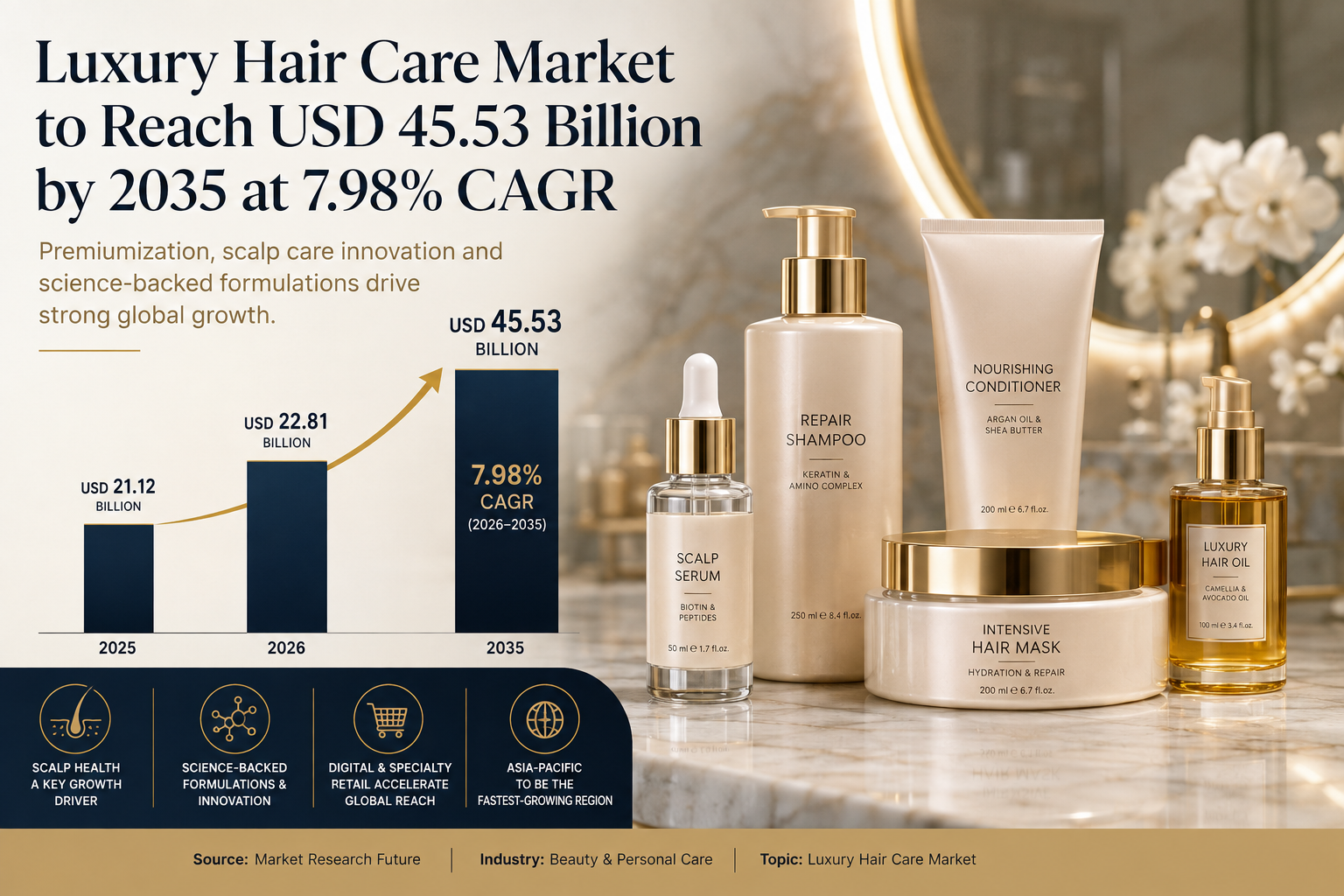

Market rises from USD 21.12 billion in 2025 to USD 45.53 billion by 2035 as scalp care, premiumization, innovation and digital retail reshape the category.
NEW YORK, NY, UNITED STATES, August 31, 2026 /EINPresswire.com/ — The global luxury hair care market is entering a sustained period of expansion as consumers increasingly treat hair and scalp care as an extension of premium beauty, wellness and personal identity. According to Market Research Future, the global Luxury Hair Care Market was valued at USD 21.12 billion in 2025 and is projected to increase from USD 22.81 billion in 2026 to USD 45.53 billion by 2035, representing a 7.98% compound annual growth rate (CAGR) during the forecast period.
The projected growth reflects a structural shift in how consumers approach haircare. Luxury hair products are increasingly positioned not simply as cleansing or styling products, but as sophisticated treatment systems designed around repair, scalp health, personalization, ingredient transparency, professional expertise and measurable performance.
The category is benefiting from several converging trends, including premiumization across beauty and personal care, increasing consumer interest in scalp health, growing demand for science-backed formulations, social-commerce discovery, salon influence, digital replenishment models and the expansion of premium beauty consumption across emerging markets.
At the same time, regulatory developments are raising the importance of product documentation and safety substantiation. In the United States, the Modernization of Cosmetics Regulation Act of 2022 significantly expanded the U.S. Food and Drug Administration’s authority over cosmetics. Among other requirements, the law established facility registration, product listing and serious-adverse-event reporting obligations and requires responsible persons to maintain records supporting adequate safety substantiation for cosmetic products.
Premiumization Reshapes the Global Hair Care Industry
Luxury hair care is increasingly benefiting from the broader premiumization of beauty consumption. Consumers who may be selective about discretionary spending are nevertheless willing to invest in products that promise targeted benefits, superior sensorial experiences, professional credibility or specialized treatment.
Haircare has an advantage within the luxury beauty landscape because it combines recurring consumption with visible and highly personal results. Unlike occasional luxury purchases, shampoos, conditioners, masks, oils, serums and scalp treatments are replenished regularly, creating opportunities for brands to build long-term relationships with consumers.
The Market Research Future market assessment identifies shampoos as the largest product category, accounting for approximately 35.2% of the market in 2025. Conditioners represent another significant portion of demand, while hair oils, styling products, masks, serums and treatment products are creating additional growth opportunities.
The expansion of treatment-oriented products is particularly important. Consumers are moving beyond basic cleansing toward multi-step regimens that address dryness, breakage, color damage, heat exposure, frizz, thinning concerns and scalp condition.
This shift enables luxury haircare brands to increase basket size by introducing complementary products within a single regimen. A consumer may begin with a premium shampoo and subsequently add a conditioner, mask, treatment oil, serum or scalp product, creating a broader recurring purchase cycle.
Get Full PDF Sample Copy of Report: (Including Full TOC, List of Tables & Figures, Chart) @ https://www.marketresearchfuture.com/sample_request/18868
Scalp Health Emerges as a Major Growth Opportunity
One of the most important developments in luxury haircare is the growing emphasis on scalp health.
The scalp is increasingly treated as the foundation of healthy-looking hair, encouraging brands to develop products that sit between traditional haircare, skincare and professional treatments. Scalp serums, exfoliating treatments, pre-shampoo products, microbiome-focused formulations and diagnostic services are becoming increasingly visible within prestige beauty portfolios.
According to Market Research Future, scalp-health category expansion represents one of the important forces supporting the future development of the luxury hair care market. The report also highlights diagnostic-led personalization as a significant opportunity, with instrumented scalp imaging and app-based hair diagnostics creating possibilities for brands to sell personalized regimens rather than individual products.
This trend is changing the competitive proposition of luxury haircare. Instead of competing primarily on fragrance, packaging or brand heritage, companies are increasingly competing on formulation technology, ingredient provenance, clinical-style evidence, diagnostics and personalized recommendations.
The result is a category increasingly influenced by the language and expectations of skincare.
Science-Backed Formulations Strengthen Consumer Confidence
Innovation in formulation science is another major contributor to market growth.
Luxury consumers are becoming more knowledgeable about ingredients and increasingly interested in understanding why a product works. This has encouraged brands to highlight peptides, botanical extracts, oils, proteins, bond-building technologies and other specialized active ingredients.
Market Research Future identifies molecular bond-building innovation as one of the long-term growth drivers for the category. Such technologies have helped move premium haircare toward mechanism-based product positioning, where brands emphasize the specific process or technology behind a product’s performance.
The same shift is visible in scalp care, where consumers increasingly encounter products positioned around specialized formulations and targeted concerns.
Ingredient transparency is also becoming more important. Consumers increasingly want to know what is inside the products they purchase, where ingredients originate and what evidence supports performance claims.
This development aligns with the changing regulatory environment. The U.S. Food and Drug Administration states that the Modernization of Cosmetics Regulation Act requires responsible persons to ensure adequate safety substantiation and maintain records supporting the safety of cosmetic products. The law also established new registration and product-listing requirements for relevant facilities and marketed cosmetic products.
For luxury brands, compliance is therefore becoming more closely connected with reputation, retailer relationships and consumer trust.
U.S. Cosmetic Regulation Raises the Compliance Bar
The U.S. regulatory environment represents an important development for prestige haircare companies selling into the American market.
The Modernization of Cosmetics Regulation Act is the most significant expansion of the U.S. Food and Drug Administration’s authority over cosmetics since the Federal Food, Drug, and Cosmetic Act of 1938. Under the framework, manufacturers and processors must register qualifying facilities with the agency and renew registrations every two years, while responsible persons must list marketed cosmetic products and update listings annually.
The U.S. Food and Drug Administration issued updated guidance on cosmetic facility registration and product listing in December 2024, providing additional instructions concerning who is responsible for submissions, what information must be provided and how submissions should be made.
For luxury haircare brands, the regulatory development reinforces the value of strong quality systems, supplier documentation, formulation records and substantiation processes.
The effect extends beyond large multinational companies. Emerging prestige brands seeking shelf space in specialty retailers, department stores and professional channels increasingly need to demonstrate that their products are supported by appropriate documentation and quality practices.
As a result, regulatory readiness can become a competitive differentiator in addition to being a compliance obligation.
Specialty Retail Remains Important as Online Channels Accelerate
Luxury haircare continues to benefit from the advisory nature of specialty retail and professional salons. According to Market Research Future, specialty stores accounted for approximately 36.5% of the market in 2025, making them an important distribution channel for prestige products. Online retail, however, is among the faster-growing channels, supported by subscription replenishment, creator-led discovery and digital consumer engagement.
The combination of physical expertise and digital convenience is reshaping the customer journey.
Salons and trained retail professionals can introduce consumers to specialized treatments, assess hair concerns and recommend multi-product regimens. Digital channels then allow consumers to research ingredients, compare products, watch demonstrations, read reviews and replenish products without returning to a physical store.
Social commerce is further compressing the traditional discovery cycle. Haircare tutorials, before-and-after demonstrations, stylist recommendations and creator content can introduce new products to large audiences almost instantly.
For brands, this creates opportunities to combine professional credibility with digital storytelling.
Asia-Pacific Expected to Deliver Strong Growth
Geographically, Asia-Pacific is emerging as one of the most attractive growth regions for luxury haircare.
Market Research Future projects Asia-Pacific to record a CAGR of approximately 9.9% during the forecast period, faster than the overall global market. The region is being supported by rising disposable incomes, premium beauty adoption, scalp-care innovation, live commerce, local beauty brands and expanding digital distribution.
China, Japan, South Korea, India and Southeast Asian markets each provide distinct opportunities.
South Korea continues to influence global beauty trends through derma-inspired formulations, scalp-focused products and digitally native beauty innovation. Japan offers opportunities around premium heritage, aging-hair solutions and advanced formulation technology.
India represents another significant opportunity. Market Research Future identifies India as one of the faster-growing markets within Asia-Pacific, supported by urban affluence, premiumization and interest in oil-based and treatment-oriented haircare formats.
The growing availability of quick-commerce and online beauty platforms is also reducing traditional distribution barriers, enabling premium products to reach consumers outside established luxury retail centers.
Europe Maintains a Strong Premium Position
Europe remains a critical market for luxury haircare, supported by established salon networks, premium beauty traditions, specialty retail and demand for sophisticated formulations.
According to Market Research Future, Europe accounted for approximately 32.1% of the luxury hair care market in 2025. Professional salons remain particularly important because consumers often rely on stylists for product recommendations, treatment advice and specialized services.
The European market is also influencing product development around clean formulations, refill systems and sustainability.
As environmental marketing claims face greater scrutiny, brands are increasingly required to substantiate statements concerning natural ingredients, sustainability and environmental performance. This creates both compliance challenges and opportunities for companies able to provide credible evidence across their supply chains.
Men’s Luxury Haircare Creates an Additional Growth Engine
Women remain the largest end-user segment, but men’s luxury haircare is becoming an increasingly important source of incremental growth.
Market Research Future estimates that women represented approximately 63.1% of the market in 2025, while the men’s segment is projected to grow at approximately 8.6% CAGR. The expansion is being encouraged by greater acceptance of specialized grooming routines, scalp-health products and thinning-management propositions.
Men’s premium haircare is increasingly moving beyond traditional shampoo and styling products. Consumers are being introduced to multi-step routines involving scalp treatments, conditioners, serums, oils and specialized styling products.
Barbershops, professional grooming channels and digital creators are playing an important role in normalizing these expanded routines.
Natural, Organic and Transparent Products Gain Momentum
The natural and organic segment represents another important opportunity within luxury haircare.
While conventional formulations remain dominant because of their established performance and scalability, Market Research Future identifies natural and organic products as a faster-growing area, supported by demand for ingredient transparency and consumer interest in perceived clean-beauty attributes.
Luxury consumers increasingly expect premium products to combine performance with responsible sourcing, transparent ingredient communication and credible sustainability practices.
However, the category is also becoming more sophisticated. Consumers are increasingly distinguishing between genuine formulation innovation and marketing language that lacks meaningful evidence.
This makes credible certification, traceability, testing and substantiation increasingly valuable for premium brands.
Competitive Landscape Becomes More Innovation Driven
The luxury haircare market features a combination of large multinational beauty groups, professional haircare companies and independent prestige brands.
Market Research Future profiles companies including L’Oréal Groupe, Unilever, The Estée Lauder Companies, Kao Corporation, Henkel, Shiseido, Wella Company, Procter & Gamble, Olaplex, Moroccanoil, Amorepacific and Davines Group.
Competition increasingly revolves around several strategic priorities: proprietary technologies, ingredient innovation, professional endorsement, digital engagement, personalized diagnostics, sustainability and international distribution.
Large beauty groups have advantages in research and development, manufacturing, regulatory capabilities and global distribution. Independent brands, meanwhile, can compete through focused product propositions, community engagement, distinctive ingredient stories and rapid innovation.
This dynamic is likely to encourage continued product launches, strategic partnerships, acquisitions and expansion into adjacent scalp-care and treatment categories.
Future Outlook: Personalization, Diagnostics and Circularity
Looking toward 2035, the luxury haircare category is expected to become increasingly personalized and technology enabled.
Digital scalp diagnostics could allow consumers to receive product recommendations based on individual hair and scalp characteristics. Subscription models could connect those recommendations with automated replenishment, creating a more predictable relationship between consumers and brands.
Market Research Future also highlights first-party consumer data as an emerging strategic asset. Brands that can connect diagnostics, product usage and replenishment behavior may be able to develop more relevant regimens and strengthen customer retention.
Sustainability is expected to remain another major strategic theme. Refillable packaging, concentrates and reduced-material formats can potentially reduce packaging requirements while creating additional opportunities for repeat purchases.
Meanwhile, biotechnology and advanced ingredient development may broaden access to high-performance actives, allowing more brands to compete on efficacy rather than relying solely on luxury positioning.
Market Outlook
The projected rise from USD 21.12 billion in 2025 to USD 45.53 billion by 2035 underscores the scale of the opportunity emerging across the global luxury haircare industry. With a projected 7.98% CAGR, the market is positioned to nearly double in value over the forecast period.
The next phase of growth is expected to be defined by the convergence of luxury beauty, wellness, cosmetic science and digital personalization.
Consumers are increasingly willing to pay premium prices when products deliver credible performance, sophisticated experiences and clear value. At the same time, retailers and regulators are placing greater emphasis on product quality, documentation and substantiated claims.
For established companies, this environment favors continued investment in innovation, professional education, diagnostics and global distribution. For emerging brands, opportunities remain in specialized formulations, scalp health, personalized regimens, natural ingredients and digitally native customer experiences.
As premium beauty continues to evolve, luxury haircare is moving beyond the traditional concept of prestige shampoo and conditioner. It is becoming a broader ecosystem encompassing advanced treatments, scalp science, professional services, personalized recommendations and recurring digital relationships.
The combination of premiumization, innovation, regulatory maturity and expanding global demand is expected to keep luxury haircare among the more dynamic segments of the international beauty and personal care industry through 2035.
Discover Related Research Reports By Market Research Future:
Hair Care Styling Products Market
https://www.marketresearchfuture.com/reports/hair-care-styling-products-market-27170
Hair Care Market
https://www.marketresearchfuture.com/reports/hair-care-market-6020
Hair Perfume Market
https://www.marketresearchfuture.com/reports/hair-perfume-market-33267
Market Research Future
Market Research Future
+1 855-661-4441
email us here
Legal Disclaimer:
EIN Presswire provides this news content “as is” without warranty of any kind. We do not accept any responsibility or liability
for the accuracy, content, images, videos, licenses, completeness, legality, or reliability of the information contained in this
article. If you have any complaints or copyright issues related to this article, kindly contact the author above.

Media gallery