
BGM0504 Monotherapy Outperforms Tirzepatide in Glucose Lowering; Combination Therapy Shows Head-to-Head Superiority to Semaglutide — BrightGene’s BGM0504 Takes on Global Benchmarks in Diabetes Treatment
SUZHOU, China, Nov. 25, 2026
Press Release Disclaimer: This is a press release distributed through the XPR Media network. It has not been independently verified by our newsroom.

BGM0504 Monotherapy Outperforms Tirzepatide in Glucose Lowering; Combination Therapy Shows Head-to-Head Superiority to Semaglutide — BrightGene’s BGM0504 Takes on Global Benchmarks in Diabetes Treatment
PR Newswire
SUZHOU, China, Nov. 25, 2026
SUZHOU, China, Nov. 25, 2026 /PRNewswire/ — BrightGene’s BGM0504 injection has delivered positive results in two Phase III glucose-lowering studies in quick succession, pitting itself against tirzepatide and semaglutide, two global glucose-lowering benchmarks. In the monotherapy study, after 32 weeks of treatment with BGM0504 10 mg, glycated hemoglobin (HbA1c) declined by 2.6 percentage points from baseline; 93.4% of patients reached HbA1c <7% and 51.8% reached the stricter target of HbA1c <5.7%. The magnitude of this reduction exceeds the tirzepatide and semaglutide monotherapy results listed here, and the proportion of patients achieving strict glycemic targets is likewise outstanding.
In the combination study built on oral glucose-lowering agents, the BGM0504 10 mg group was superior head-to-head to semaglutide 1.0 mg in the Week 32 primary endpoint analysis, delivering an additional HbA1c reduction of approximately 0.46 percentage points and sustaining this advantage through Week 52; the 5 mg group also achieved statistically significant superiority in the Week 52 supplementary analysis. Using the tirzepatide SURPASS-2 study as an external reference, the BGM0504 10 mg group showed numerical advantages in both HbA1c reduction and HbA1c <5.7% attainment. From the substantial reductions and high attainment rates in monotherapy to the direct superiority and sustained glycemic control in combination therapy, BGM0504 is challenging the global glucose-lowering benchmarks with data from two Phase III studies.
Monotherapy Reduction Exceeds Tirzepatide, with Outstanding Attainment of Strict Glycemic Targets
This monotherapy Phase III study was a multicenter, randomized, double-blind, placebo-controlled, parallel-group study that enrolled 227 participants with a mean baseline HbA1c of approximately 8.3%. Participants received BGM0504 5 mg, 10 mg or placebo once weekly by subcutaneous injection, with a 32-week core treatment period followed by a 20-week extension treatment period.
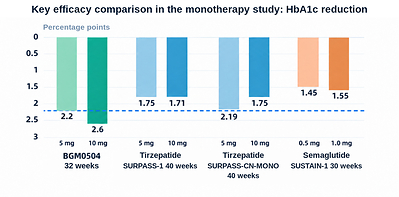
Based on the treatment-regimen estimand (TRE), at Week 32 HbA1c had decreased from baseline by 2.2 and 2.6 percentage points in the BGM0504 5 mg and 10 mg groups, respectively, versus 0.51 percentage points in the placebo group. Both dose groups achieved statistically significant superiority over placebo, and the 10 mg group also achieved statistically significant superiority over the 5 mg group. Under the efficacy estimand (EE), the reductions in the two dose groups were likewise approximately 2.2 and 2.6 percentage points, respectively; the results under the two estimands were highly consistent.
Compared with tirzepatide monotherapy studies, the numerical reduction achieved with BGM0504 stands out. In SURPASS-CN-MONO, the tirzepatide Phase III monotherapy study in China, HbA1c reductions under the TRE approach at Week 40 were 2.19, 1.75 and 2.03 percentage points in the 5 mg, 10 mg and 15 mg groups, respectively.[1] After 32 weeks of treatment, the reductions in the BGM0504 5 mg and 10 mg groups were 2.2 and 2.6 percentage points; the 5 mg group already exceeded all three of these dose groups numerically, and the 10 mg group widened the reduction further.
In the global SURPASS-1 study, Week 40 TRE reductions in the tirzepatide 5 mg and 10 mg groups were 1.75 and 1.71 percentage points, respectively; in the semaglutide SUSTAIN-1 study, reductions at Week 30 in the 0.5 mg and 1.0 mg groups were 1.45 and 1.55 percentage points.[2,3] Viewed against these cross-study figures, the BGM0504 5 mg group already showed a substantial glucose-lowering effect at Week 32, with reductions numerically higher than all listed tirzepatide and semaglutide dose groups; the 10 mg group reached 2.6 percentage points, the most pronounced among the datasets compared.
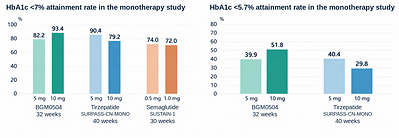
Beyond the mean reduction, another standout feature of BGM0504 is the high proportion of patients reaching glycemic targets. At Week 32, 82.2% and 93.4% of participants in the 5 mg and 10 mg groups achieved HbA1c <7%, versus 21.7% in the placebo group; 39.9% and 51.8% achieved HbA1c <5.7%, versus 2.6% with placebo. This means that in the 10 mg group more than nine in ten patients reached the HbA1c <7% target and more than half reached the stricter HbA1c <5.7% level.
Under the TRE approach, in SURPASS-CN-MONO the HbA1c <7% attainment rates in the listed tirzepatide 5 mg and 10 mg groups were 90.4% and 79.2%, and the HbA1c <5.7% rates were 40.4% and 29.8%, respectively.[1] Both attainment rates in the BGM0504 10 mg group were higher than in these two dose groups; the 51.8% strict attainment rate was 11.4 percentage points above the higher of the two, 40.4%.
Among the 5 mg and 10 mg groups listed in the global SURPASS-1 study, the HbA1c <5.7% attainment rates for tirzepatide were 30.9% and 26.8%; in the semaglutide SUSTAIN-1 study, the HbA1c <7% attainment rates in the 0.5 mg and 1.0 mg groups were 74.0% and 72.0%.[2,3] These comparisons provide a reference for understanding the glycemic control achieved with BGM0504 and show that it exceeds both tirzepatide and semaglutide in terms of both HbA1c reduction and attainment rates.
In terms of safety and tolerability, as disclosed in the announcement, BGM0504 performed well overall in the monotherapy study. The common gastrointestinal adverse reactions were overwhelmingly transient and mild to moderate, and resolved within a short time without intervention or after simple symptomatic treatment alone. Over a treatment period of up to 52 weeks, the proportion of participants discontinuing due to adverse events and the incidence of severe hypoglycemic events were both 0 in the trial groups.
Combination Therapy Superior Head-to-Head to Semaglutide, with Glucose-Lowering Comparable to Tirzepatide
Beyond the monotherapy study, another Phase III study of BGM0504 used semaglutide 1.0 mg as the active comparator to directly test its ability to further control blood glucose on top of oral glucose-lowering therapy such as metformin. The study enrolled Chinese adults with type 2 diabetes whose blood glucose remained inadequately controlled after prior oral therapy; treatment consisted of once-weekly subcutaneous injections over 52 weeks, with the primary endpoint being the change in HbA1c from baseline at Week 32.
The primary efficacy results showed that at Week 32, HbA1c decreased from baseline by 2.05, 2.41 and 1.95 percentage points in the BGM0504 injection 5 mg group, the 10 mg group and the semaglutide 1.0 mg group, respectively. The BGM0504 10 mg group reduced HbA1c by an additional 0.46 and 0.36 percentage points compared with the semaglutide 1.0 mg group and the BGM0504 5 mg group, respectively, and both comparisons achieved statistically significant superiority. By Week 52, HbA1c had decreased from baseline by 2.07, 2.34 and 1.88 percentage points in the three groups; the BGM0504 10 mg group reduced HbA1c by an additional 0.46 and 0.27 percentage points compared with the semaglutide 1.0 mg group and the 5 mg group, respectively, both achieving statistically significant superiority.
The BGM0504 injection 5 mg group also showed a sustained glucose-lowering effect. The Week 52 supplementary analysis showed that the 5 mg group reduced HbA1c by an additional 0.19 percentage points compared with the semaglutide group, achieving statistically significant superiority. These results indicate that the 10 mg group demonstrated a clear glucose-lowering advantage at both observation time points, while the 5 mg group showed superiority over semaglutide in the Week 52 supplementary analysis, further highlighting the long-term glycemic control achieved with the 5 mg group.
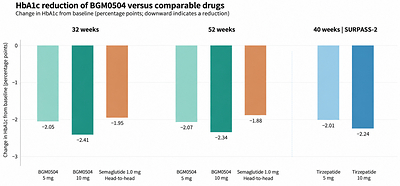
Benchmarked against tirzepatide, the global glucose-lowering standard, BGM0504 also performed strongly in the combination study. Under the TRE approach, in the SURPASS-2 study HbA1c reductions at Week 40 in the tirzepatide 5 mg and 10 mg groups were 2.01 and 2.24 percentage points[4]; in the BGM0504 study, reductions at Week 32 in the 5 mg and 10 mg groups were 2.05 and 2.41 percentage points. In this cross-study numerical comparison, the additional glucose-lowering effect of the BGM0504 10 mg group was greater than that of the tirzepatide 5 mg and 10 mg groups, indicating strong competitive glucose-lowering capability.
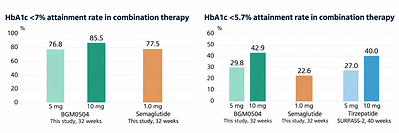
Attainment rates further demonstrate the benefit observed in the head-to-head study. At Week 32, 85.5% of the BGM0504 10 mg group achieved HbA1c <7%, compared with 77.5% in the semaglutide group, a difference of 8.0 percentage points; the proportions reaching the stricter HbA1c <5.7% target were 42.9% and 22.6%, respectively, with the BGM0504 group higher by 20.3 percentage points.
For the stricter HbA1c <5.7% target, the Week 32 attainment rates in the BGM0504 5 mg and 10 mg groups were 29.8% and 42.9%, both higher than the 27.0% and 40.0% reported at Week 40 for the corresponding dose groups in SURPASS-2.[4]
In terms of safety and tolerability, as disclosed in the announcement, BGM0504 performed well overall in the combination study. The common gastrointestinal adverse reactions were overwhelmingly transient and mild to moderate, and resolved within a short time without intervention or after simple symptomatic treatment alone. Over the 52-week treatment period, only 0.54% of participants in the trial groups discontinued due to adverse events related to the study drug, and no severe hypoglycemic events occurred.
A Dual Breakthrough in Reduction and Attainment: BGM0504 Demonstrates Potent Glycemic Control
Evaluating a glucose-lowering drug requires combining the mean HbA1c reduction with the proportion of patients actually reaching target. The former reflects overall glycemic improvement, while the latter reflects the share of patients achieving preset glycemic goals. The core value of the BGM0504 data lies in the substantial reduction and high strict-target attainment rate under the TRE approach in the monotherapy study, together with direct evidence of superiority over semaglutide in combination therapy. Numerical leadership across studies and statistically significant superiority within the same study should be understood separately.
In the monotherapy Phase III study, the BGM0504 10 mg group demonstrated potent glucose-lowering efficacy: under the TRE approach, mean HbA1c fell by 2.6 percentage points, as many as 93.4% of participants met the HbA1c <7% standard, and 51.8% reached the stricter HbA1c <5.7% target. In the combination study of patients with inadequate control on oral agents, BGM0504 also performed strikingly: the head-to-head comparison showed that its 10 mg group achieved a significantly greater HbA1c reduction than semaglutide 1.0 mg at the Week 32 primary efficacy endpoint (statistically significant superiority), with attainment rates for HbA1c <7% and <5.7% higher by 8.0 and 20.3 percentage points, respectively. This superiority in reduction remained robust at Week 52, supporting potent glycemic control sustained through 52 weeks. Considering the comparators selected in the different studies, the superiority achieved by BGM0504 directly against semaglutide 1.0 mg, and the maintenance of that advantage to Week 52, provide a more direct basis for assessing its incremental value relative to established glucose-lowering therapies.
Professor Ji Linong, principal investigator of the Phase III clinical studies of BGM0504 injection in adults with type 2 diabetes and Director of the Department of Endocrinology at Peking University People’s Hospital, said: “I am very satisfied with the results of the two Phase III clinical trials of BGM0504 injection, monotherapy and combination therapy, in adults with type 2 diabetes! Among participants in the monotherapy study, HbA1c reduction reached 2.6 percentage points, 93.4% of participants achieved HbA1c <7%, and 51.8% reached normal glycemic levels (HbA1c <5.7%). In the combination therapy groups, the head-to-head comparison of BGM0504 with semaglutide showed that the 10 mg group met the prespecified non-inferiority criteria and achieved statistically significant superiority versus semaglutide at both Week 32 and Week 52; the 5 mg group also met non-inferiority at Week 32 and achieved superiority in the Week 52 supplementary analysis; in the 10 mg group, HbA1c reduction at Week 32 reached 2.41 percentage points, 85.5% of participants achieved HbA1c <7%, and 42.9% reached normal glycemic levels (HbA1c <5.7%). Moreover, key secondary endpoints such as fasting plasma glucose improved significantly, and cardiometabolic indicators such as body weight and blood pressure showed clear benefits. Even more encouraging is the favorable safety profile demonstrated by BGM0504. I very much look forward to these two studies providing key supporting evidence for the approval and launch of BGM0504 and offering an efficacious and safe treatment option for the many patients with type 2 diabetes.”
Dr. Yuan Jiandong, Chairman of BrightGene, said: “The philosophy of chronic disease management for adults with diabetes in China is continuously evolving. It is no longer limited to controlling glucose values, but has shifted toward comprehensive management that also addresses overall cardiometabolic improvement, reduces the risk of complications and enhances long-term quality of life. For the many patients with type 2 diabetes, a drug that simultaneously improves key metabolic indicators such as body weight, blood pressure and lipids would bring entirely new value to long-term disease management. We will make every effort to accelerate the new drug application for BGM0504, and we look forward to this innovative polypeptide therapy benefiting patients as early as possible, carrying forward our vision of empowering chronic disease management with innovative medicines and benefiting patients at large, and providing a new treatment option for the Chinese type 2 diabetes population that combines glucose lowering with metabolic protection.”
|
Data Sources |
|
[1] Tirzepatide (Eli Lilly), SURPASS-CN-MONO study. Yin Y, Ma J, Liu D, et al. Tirzepatide monotherapy in Chinese patients with early type 2 diabetes: A randomized, double-blind, placebo-controlled phase 3 trial (SURPASS-CN-MONO). Med. 2026;7:101183. The Week 40 TRE reductions and HbA1c attainment rates cited in this text are shown in the publicly available supplementary materials, Table S2 and Figure S2 (Table S2 begins on page 5 of the supplementary PDF). DOI: 10.1016/j.medj.2026.101183 (publicly available supplementary materials). |
|
[2] Tirzepatide (Eli Lilly), SURPASS-1 study. Rosenstock J, Wysham C, Frías JP, et al. Efficacy and safety of a novel dual GIP and GLP-1 receptor agonist tirzepatide in patients with type 2 diabetes (SURPASS-1): a double-blind, randomised, phase 3 trial. Lancet. 2021;398(10295):143–155. The Week 40 TRE reductions and HbA1c <5.7% attainment rates cited in this text are shown in the publicly available supplementary materials, Table S6 (Treatment-Regimen Estimand, supplementary PDF from page 15). DOI: 10.1016/S0140-6736(21)01324-6 |
|
[3] Semaglutide (Novo Nordisk), SUSTAIN 1 study. Sorli C, Harashima SI, Tsoukas GM, et al. Efficacy and safety of once-weekly semaglutide monotherapy versus placebo in patients with type 2 diabetes (SUSTAIN 1): a double-blind, randomised, placebo-controlled, parallel-group, multinational, multicentre phase 3a trial. Lancet Diabetes Endocrinol. 2017;5(4):251–260. The Week 30 HbA1c reductions cited in this text are shown in Table 2, and the HbA1c <7% attainment rates in Table 3. DOI: 10.1016/S2213-8587(17)30013-X |
|
[4] Tirzepatide (Eli Lilly), SURPASS-2 study. Frías JP, Davies MJ, Rosenstock J, et al. Tirzepatide versus Semaglutide Once Weekly in Patients with Type 2 Diabetes. N Engl J Med. 2021;385:503–515. The Week 40 TRE reductions cited in this text are shown in the main text and Figure 1A, the HbA1c <5.7% attainment rates in Figure 1C, and mean baseline HbA1c in Table 1. DOI: 10.1056/NEJMoa2107519 |
 View original content to download multimedia:https://www.prnewswire.com/news-releases/bgm0504-monotherapy-outperforms-tirzepatide-in-glucose-lowering-combination-therapy-shows-head-to-head-superiority-to-semaglutide–brightgenes-bgm0504-takes-on-global-benchmarks-in-diabetes-treatment-302950554.html
SOURCE BrightGene

